
Sheepshead, the Fish With Teeth Like a Person’s
Why it has human-looking teeth, and how to catch one around Hilton Head’s docks, piers and reefs.
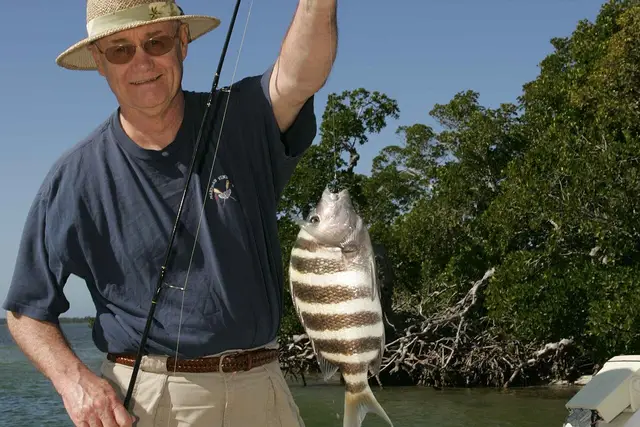
Photo: a sheepshead caught in the mangroves of Florida. Steve Hillebrand, U.S. Fish and Wildlife Service, public domain.
The fish with human teeth is the sheepshead, a striped saltwater fish that lives along the whole Southeast coast and all around Hilton Head. Open its mouth and you see a row of flat front teeth that look like someone’s dentures, with rounded molars behind them. A 2022 photo of one caught off Jennette’s Pier in the Outer Banks went viral for exactly that reason. Here it is a familiar fish: locals catch them off docks, piers and bridge pilings every winter, and they are one of the best-eating fish in the water.
Why a Sheepshead Has Teeth Like a Person’s
The teeth are tools for a shellfish diet. A sheepshead eats barnacles, oysters, mussels, clams, crabs and shrimp, plus some algae, and most of that food is stuck to something hard or wrapped in a shell. The front of each jaw carries broad, flat, incisor-like teeth, four on each side, that it uses to nip and pry barnacles and small oysters off a dock piling or a rock. Behind them sit several rows of rounded, molar-like teeth that crush the shells so it can eat what is inside.
They look human because they do a similar job. Our incisors cut and our molars grind, and the sheepshead has ended up with the same two kinds of tooth for the same reason, even though it is no relation. The name comes from the same face: to the people who named it, the blunt snout and big front teeth looked like a sheep’s. The five or six dark bars down its sides earn it another nickname, the convict fish.
Can it bite you? It can give a finger a hard pinch while you unhook it, so use pliers. The sharp spines along its back are the bigger hazard, so grip it from the front and fold the fin down as you take hold.
Other Fish With Teeth
The sheepshead is the one people mean when they talk about human teeth, but a few other fish come close, and several of them swim off Hilton Head too:
Pacu: a South American freshwater relative of the piranha with square, very human-looking teeth for cracking nuts and seeds. It turns up in American lakes now and then after someone releases an aquarium fish.
Gray triggerfish: caught offshore here, on the same reefs as sheepshead. It has small, chisel-like front teeth strong enough to crunch crabs and urchins.
Black drum: a sheepshead’s neighbor around the docks and oyster beds. Its crushing teeth sit in its throat instead of its jaws, so you only see them if you clean one.
Bluefish, Spanish mackerel and sharks: the sharp-toothed end of the list, all caught off the island in the warmer months. Handle every one of them with pliers.
Where to Catch Sheepshead on Hilton Head
Find the barnacles and you find the sheepshead. They hold tight to anything hard in the water: dock and bridge pilings, oyster clusters, rocks and wrecks. From land, the Charles C. Haigh Jr. Fishing Pier on Pinckney Island is the place to try: deep, moving water and plenty of pilings, with free parking. The smaller House Creek Fishing Pier sits over shallow tidal water and is better for crabbing. Our guide to the fishing piers compares the two.
With a boat, the creek docks and bridge pilings along Broad Creek, Skull Creek and Calibogue Sound all hold fish, and so do the oyster rakes at low tide. Stay on public water and don’t tie up to private docks. In the coldest weeks the biggest fish move out to the nearshore reefs and wrecks, such as the Fish America reef and the General Gordon wreck, both under five miles off the beach. Local charter captains know these spots well, and a half-day inshore trip in winter is often a sheepshead trip: see Hilton Head fishing to book one, or the Shelter Cove Harbour charters Hilton Head Sport Fishing and Bay Runner Fishing Charters.
When to Go: Sheepshead Season
Sheepshead live in South Carolina water all year, but the cooler months are their season. From late fall into winter they crowd the docks and pilings inshore. In late winter and early spring they gather on the nearshore reefs and wrecks to spawn, which is when the biggest fish of the year are caught. They come back into the creeks through the spring. In summer they are still around, but the bait stealers get to your crab first. The average fish is about 14 inches and 3 pounds; the state record is 16 pounds, 6 ounces, and they can live to about 25.
Fish the slower water around the turn of the tide, when you can hold a light rig straight down beside a piling. The Hilton Head tide chart has the times.
Bait and How to Hook One
Fiddler crabs are the classic bait, and local captains swear by them. You can buy them at local bait and tackle shops in season, or catch your own on the mud at low tide. Pieces of blue crab, oysters, clams, barnacles scraped off the piling, and live shrimp all work too, and shrimp is the usual choice on the reefs.
Rig: a short leader, a small, strong hook (around a 1/0), and only as much weight as it takes to hold bottom in the current.
Placement: drop straight down, tight against the piling. A foot away is often too far.
The bite: a sheepshead crunches the bait rather than running with it, so the bite is a faint tap. Lift and set the hook hard at the first sign. The old line is that you have to set the hook just before he bites.
Chum: scraping a few barnacles off the piling with a shovel or rake brings them in.
South Carolina Size and Bag Limits
The South Carolina Department of Natural Resources (SCDNR) sets the rules. A sheepshead has to be at least 14 inches long, measured to the tip of the tail, and you can keep 10 per person per day, with no more than 30 per boat per day. Anyone 16 or older needs a South Carolina saltwater fishing license, including on the island’s free public piers. Check the current limits on the SCDNR website before you go, since the state can change them.
Eating Sheepshead
This is the reward for all that work. A shellfish diet gives sheepshead firm, white, mild meat that many anglers rank among the best on the coast, with a sweetness people compare to crab. Cleaning one is the hard part: the scales are thick, the spines are sharp, and the rib cage is tough, so most people fillet them with an electric knife and leave the skin on the carcass. The fillets are small for the size of the fish.
Fry them, blacken them, or bake them with butter and lemon. A whole scaled fish on the grill is a Lowcountry favorite. For a fish dinner without the cleaning, see our guide to seafood restaurants on Hilton Head.
Frequently Asked Questions
What fish has human teeth?
The sheepshead. It has broad, flat, incisor-like teeth at the front of its jaws and rows of molar-like teeth behind them, which is why photos of its mouth look like human dentures. The South American pacu has similar teeth.
Why does a sheepshead have teeth like a human?
It eats barnacles, oysters, clams and crabs. The front teeth pry shellfish off pilings and rocks, and the molars behind them crush the shells, the same cut-and-grind job our own teeth do.
Where can you catch sheepshead on Hilton Head?
Around anything with barnacles on it: dock and bridge pilings, oyster beds and rocks. From land, try the Charles C. Haigh Jr. Fishing Pier on Pinckney Island. By boat, the creek docks and the nearshore reefs and wrecks a few miles off the beach.
When is sheepshead season in South Carolina?
Sheepshead are here all year, but the cooler months are best: late fall and winter around the docks and pilings, and late winter into spring on the nearshore reefs, where they spawn.
What is the sheepshead limit in South Carolina?
At least 14 inches total length, 10 per person per day, and no more than 30 per boat per day, under SCDNR rules. Anglers 16 and older need a saltwater fishing license.
What is the best bait for sheepshead?
Fiddler crabs. Pieces of crab, oysters, clams, barnacles and live shrimp also work, fished straight down beside a piling.
Are sheepshead good to eat?
Yes. The meat is white, firm and mild, a little sweet from their shellfish diet. They are hard to clean because of the thick scales and sharp spines, so most people fillet them with an electric knife.
Local guides like this come standard for Guests of Partner Properties — one small part of what a Partner Property gives every guest.
Book Partner Properties