
What Is Spanish Moss, and Where Does It Come From?
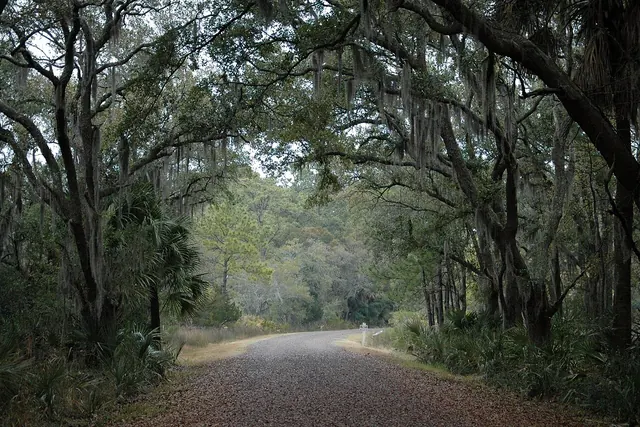
It isn’t a moss or from Spain, and it doesn’t hurt the live oaks it hangs from. What it is and where to see it here.
Live oaks hung with Spanish moss over a trail on Pinckney Island National Wildlife Refuge.
Spanish moss is the gray, hanging, beard-like plant draped over the live oaks of the Lowcountry. Despite the name it is not a moss and has no connection to Spain. It is a flowering plant in the bromeliad family, the same family as the pineapple, and it lives its whole life up in the air without roots. Its scientific name is Tillandsia usneoides.
How Spanish Moss Grows on Trees
Spanish moss makes its living from air. Tiny scales on its thin, curling leaves soak up rain and the dissolved minerals in it, along with moisture and dust from the air, and it makes its own food from sunlight. The tree is only a place to hang. That makes it an epiphyte, a plant that grows on another plant without feeding on it, and not a parasite. It spreads in two ways. The plant makes tiny seeds, and pieces break off in the wind and snag on a branch, where they keep growing. Birds also carry strands off to line their nests, and that moves it from tree to tree.
Does Spanish Moss Kill Trees?
Almost never. It takes nothing from the tree, so a live oak carries it for centuries with no harm. The only real cost is on a tree that is already struggling: a very thick growth shades the leaves beneath it, and wet moss is heavy enough to stress a weak limb. A healthy tree shrugs it off. The moss itself is touchy about air: it does not grow where smoke and pollution are heavy.
What Trees Does Spanish Moss Grow On?
It will hang on almost anything it can catch hold of, but it favors southern live oaks and bald cypress. Both have leaves that wash minerals out in the rain, which is the moss’s food supply, and live oaks have wide, rough, level limbs that hold strands in place. You also see it on sweetgum, crape myrtle, pines and even power lines. Of all the Hilton Head trees, the live oak is the one you will notice it on first, because it holds so much of it.
Where Does Spanish Moss Come From?
It is a native of the Americas, not an import. Where did Spanish moss come from? It grew wild across the warm, humid parts of the continent long before anyone named it: the southern United States, Mexico, Central America, the Caribbean and South America as far south as northern Patagonia, the widest range of any bromeliad. In the United States it runs up the Atlantic coast to Virginia and around the Gulf, wherever there is warmth, moisture and clean air. People have since carried it to places like Hawaii, and the “Spanish” in its name is folklore: the plant has no tie to Spain.
Spanish Moss on Hilton Head
Spanish moss Hilton Head visitors photograph most hangs from the live oaks around Harbour Town, where the Liberty Oak is one of the island’s best-known trees. For a walk under it, try the live-oak trails of the Sea Pines Forest Preserve or the trails of Pinckney Island (the photo above). It looks best after rain, when the gray strands turn silvery green.
Leave it where it hangs. Pinckney Island is a national wildlife refuge, and on refuge and park land plants are not there to be collected. On your own property or a rental’s grounds, strands that fall after a storm are fair game for crafts.
Who Lives in It, and the Chigger Question
Bats roost in it, birds line their nests with it, rat snakes slip through it, and one tiny jumping spider lives nowhere else. The old warning that Spanish moss is full of chiggers is mostly a myth: a scientific survey of the small creatures living on it found them missing among thousands. It is still wild plant matter, so shake out anything you bring home.
What Spanish Moss Was Used For
Cured moss was stuffing for mattresses, upholstery and, in the early 1900s, car seats, and by 1939 more than 10,000 tons a year were being harvested. Today it is mostly a craft and gardening material, used for hanging baskets and wreaths and as bedding.
More Nature on Hilton Head
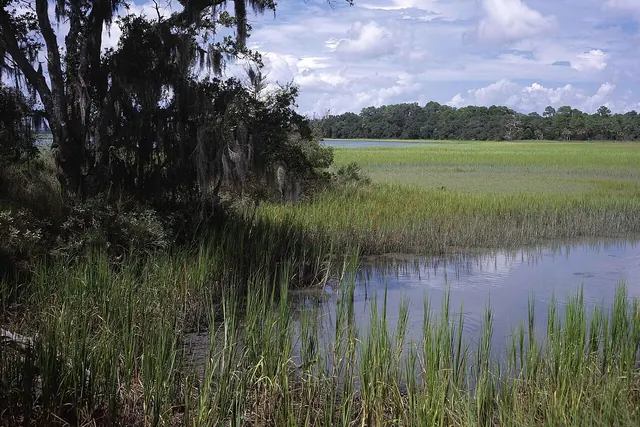
Hilton Head wildlife and nature, answered: dolphins, alligators, birds, Spanish moss, pluff mud and butterflies, and where to see them safely.
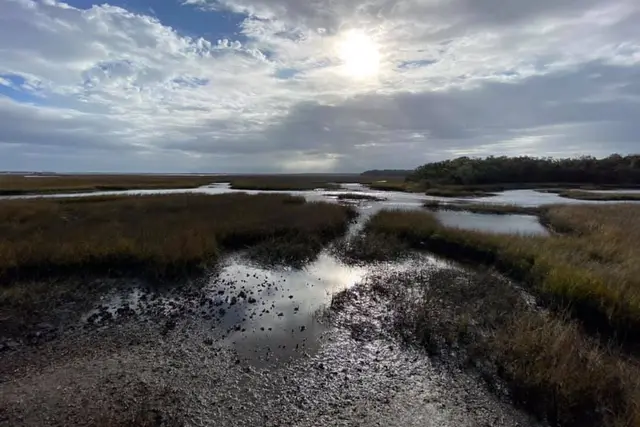
Pluff mud is the soft, sulfur-smelling mud of the Lowcountry marsh. What it is, why it smells, what grows out of it and how to avoid getting stuck.
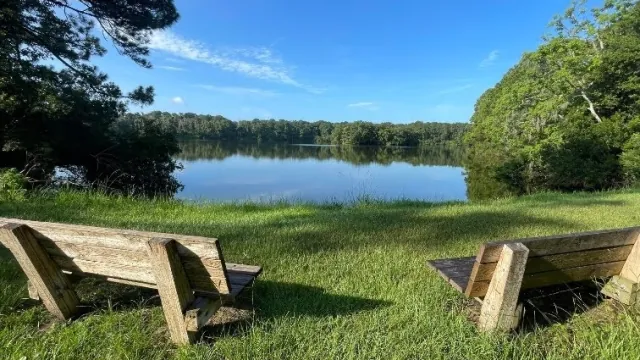
Sea Pines Forest Preserve on Hilton Head: 605 acres, trails, the Shell Ring, Fish Island, alligator tours, hours, parking, and the gate fee.
Frequently Asked Questions
What is Spanish moss?
A flowering plant in the bromeliad (pineapple) family that hangs from trees across the Southeast. It is not a moss and not from Spain. It has no roots and takes water and minerals from the air and rain.
Is Spanish moss a parasite?
No. It is an epiphyte: it uses the tree only as a place to hang and takes nothing from it.
Does Spanish moss kill trees?
Almost never. A very thick growth can shade the leaves of a weak tree, and wet moss can weigh down a failing limb, but healthy live oaks carry it for centuries.
What trees does Spanish moss grow on?
Mostly southern live oaks and bald cypress, which shed the minerals it feeds on in the rain. It also hangs on sweetgum, crape myrtle and pines.
Where does Spanish moss come from?
It is native to the Americas, from the southern United States through Mexico and Central America to northern Patagonia. It spreads by tiny seeds and by wind-blown pieces and birds carrying strands for nests.
Does Spanish moss have chiggers?
It is a common warning but mostly a myth. A study of the small creatures living on Spanish moss found chiggers absent.
Where can you see Spanish moss on Hilton Head?
On live oaks around Harbour Town and the Liberty Oak, along the trails of the Sea Pines Forest Preserve and on Pinckney Island.
Local guides like this come standard for Guests of Partner Properties — one small part of what a Partner Property gives every guest.
Book Partner Properties