
Gulf Fritillary: The Orange Butterfly of the Lowcountry
How to tell a gulf fritillary from a monarch, what its spiny orange caterpillars eat, and when to see them.
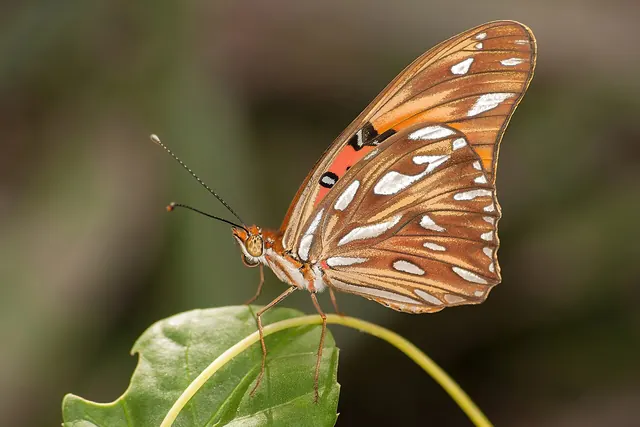
A gulf fritillary at rest, wings closed, showing the silver spots on the underside.
The gulf fritillary is the bright orange butterfly you see flapping around Lowcountry gardens, roadsides and marsh edges from late summer into fall. It is common here and easy to recognize once you know two things: the orange wings are streaked with black, and when it lands and folds them, the underside flashes silver.
How to Identify a Gulf Fritillary
Top of the wings: deep orange with black streaks, bars and spots. The front wings are long and pointed.
Underside: brown, covered in silvery-white spots that look like drops of metal. This is the surest sign, and you see it whenever the butterfly rests with its wings closed.
Size: medium, with a wingspan of roughly 2.5 to 3.75 inches. Females are a little larger and darker than males.
Flight: fast and bouncy, close to the ground and around flowers and vines.
Gulf Fritillary or Monarch?
Most orange butterflies in a Hilton Head yard get called monarchs, and most of them are gulf fritillaries. A monarch is larger, with thick black veins and a black border dotted with white spots, and it glides more than it bounces. The gulf fritillary has black streaks and spots on the orange, narrower wings, and the silver-spotted underside no monarch has. The variegated fritillary, another orange butterfly of the Southeast, is duller and has no silver at all.
The Orange Caterpillars With Spines
If you have seen a vine covered in bright orange caterpillars with long black spines, that is this butterfly. The spines look like they would sting, but they are soft and harmless. The caterpillars eat only passion vines, and the one that grows wild around the Lowcountry is maypop (Passiflora incarnata), a native passionflower with lavender, fringed blooms. The mother lays tiny yellow eggs one at a time on the vine, which turn brownish-red within a day, and the caterpillars take two to three weeks to grow before they hang as a chrysalis. A vine can be stripped to sticks. It grows back, and that is the butterflies working as they should.
When to See Them
Gulf fritillaries have several broods a year, and the numbers build as the summer goes on. In the Lowcountry they peak from August through November, which is why they are called a sure sign of fall here. You can see a few earlier in the season, and warm spells in winter can bring one out. Look on sunny days around flower beds, sunny fence lines and anywhere a passionflower vine is climbing.
Where to See Butterflies on Hilton Head
You do not need a special trip for a gulf fritillary: a flowering garden or a sunny trail edge in September is enough. For a place built for butterflies, the Coastal Discovery Museum at Honey Horn keeps the Karen Wertheimer Butterfly Habitat on its grounds, along the nature walk behind the Discovery House. Admission to the museum grounds is free, and the museum posts its current hours and what is flying. The island’s trails are good for the other butterflies of the marsh and pine forest too: see the Sea Pines Forest Preserve and Pinckney Island.
Plant a Butterfly Garden
Two plants do most of the work. A passionflower vine, native maypop if you can find it, feeds the caterpillars. Lantana, Mexican sunflower and other sunny, nectar-rich flowers feed the adults. Skip the insecticides: they kill caterpillars along with everything else, and let the vine take a beating in late summer.
Not Poisonous, but Don’t Handle Them
Gulf fritillaries are not dangerous to people. They taste bad to birds and other predators, and they give off a smell when grabbed, so there is no reason to pick one up. Their wings are easily damaged by handling, so photograph them instead.
More Nature on Hilton Head
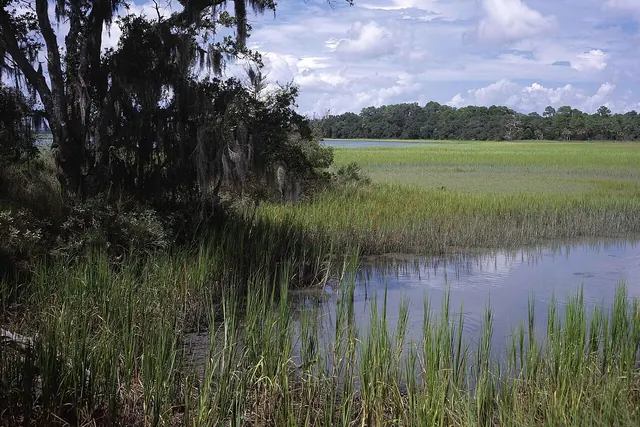
Hilton Head wildlife and nature, answered: dolphins, alligators, birds, Spanish moss, pluff mud and butterflies, and where to see them safely.
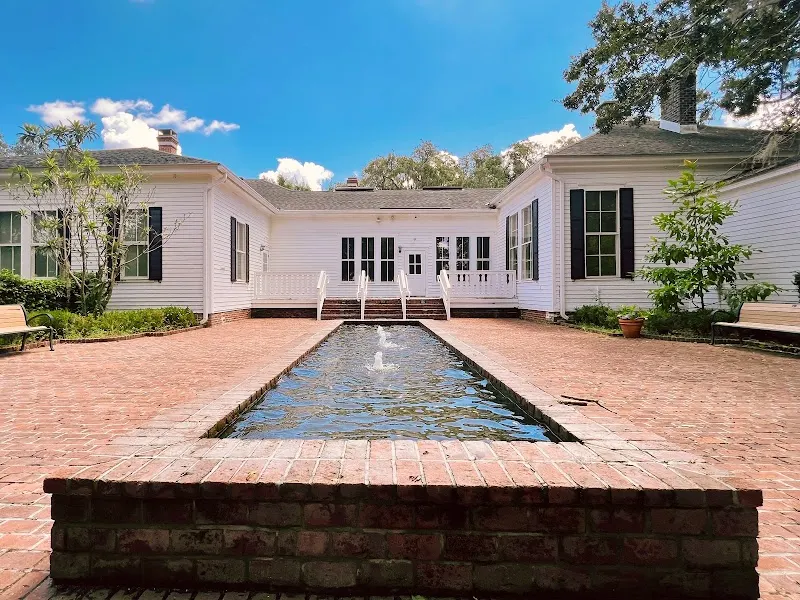
The Coastal Discovery Museum at Honey Horn: free admission, hours, tours and cruises, the farmers market and how to visit this Smithsonian Affiliate.
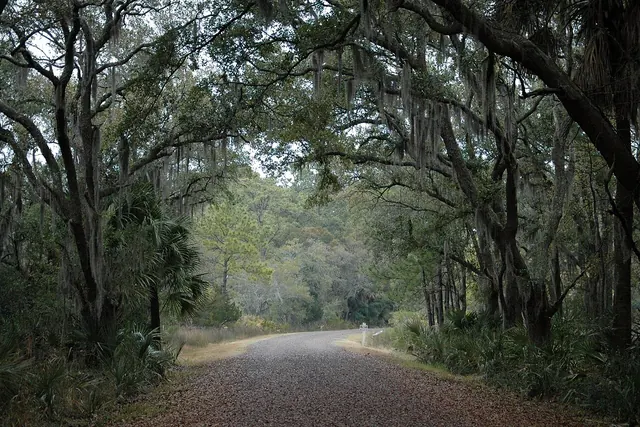
What is Spanish moss, where does it come from and what trees does it grow on? It is a flowering plant, not a moss, and it does not kill the oaks.
Frequently Asked Questions
What does a gulf fritillary look like?
A medium orange butterfly with black streaks and spots on top and a brown underside covered in silvery-white spots. The silver spots are the giveaway when it lands with its wings closed.
Is a gulf fritillary a monarch?
No. A monarch is larger, with black veins and a black border dotted with white. The gulf fritillary has black streaks on narrower orange wings and a silver-spotted underside.
What do gulf fritillary caterpillars eat?
Only passion vines. Around Hilton Head that is mostly maypop, the native passionflower. A vine can be eaten down to bare stems and will usually grow back.
Do gulf fritillary caterpillars sting?
No. The long black spines on the orange caterpillar are soft and only look dangerous.
When are gulf fritillaries in the Lowcountry?
Most of the year in warm weather, with numbers building through summer and peaking from August through November.
How do you spell gulf fritillary?
F-r-i-t-i-l-l-a-r-y, with one T after the first I. It is often searched as "gulf frittilary", and the butterfly is the same one.
Where can you see butterflies on Hilton Head Island?
Any sunny garden with flowers, trail edges in the Sea Pines Forest Preserve and on Pinckney Island, and the Karen Wertheimer Butterfly Habitat at the Coastal Discovery Museum on Honey Horn.
Local guides like this come standard for Guests of Partner Properties — one small part of what a Partner Property gives every guest.
Book Partner Properties